


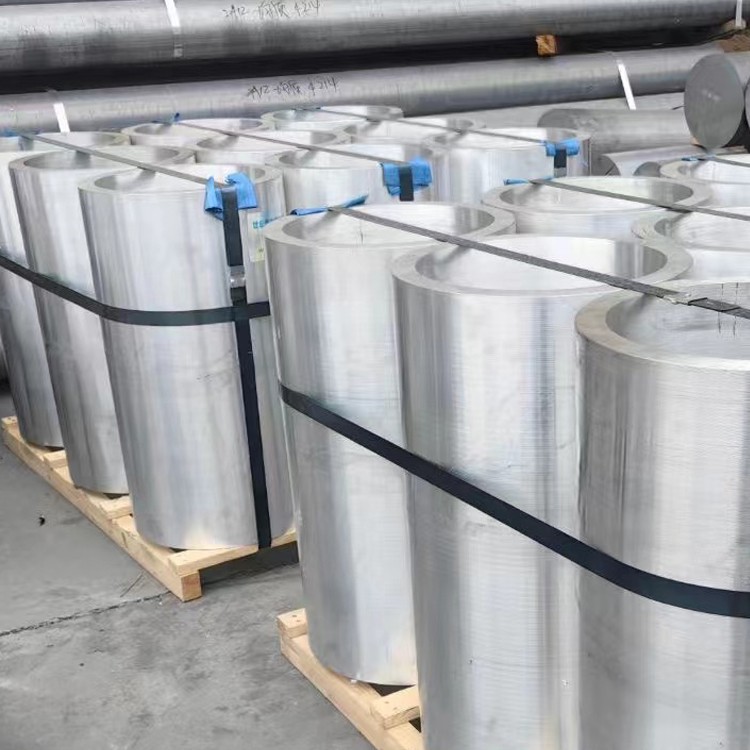

5083 Aluminum Forging Pipe for Marine
5083 aluminum alloy is a high magnesium alloy with good strength, corrosion resistance, and machinability among non heat treatable alloys.
1. Material Composition & Forging Process
5083 marine-grade aluminum forging pipes comply with ASTM B247, EN 754-2, and NORSOK M-121 standards with optimized magnesium-manganese composition for seawater corrosion resistance:
Primary Alloying Elements:
Magnesium (Mg): 4.0-4.9% (enhances strength and corrosion resistance)
Manganese (Mn): 0.4-1.0% (controls grain structure)
Chromium (Cr): 0.05-0.25% (improves stress corrosion cracking resistance)
Base Material:
Aluminum (Al): ≥93.5% (balance)
Impurity Limits:
Iron (Fe): ≤0.40% max
Silicon (Si): ≤0.40% max
Copper (Cu): ≤0.10% max (critical for marine corrosion)
Zinc (Zn): ≤0.25% max
Marine-Specific Forging Process:
Preheating: 380-420°C in controlled atmosphere furnaces
Forging Parameters:
Temperature range: 320-380°C
Reduction ratio: ≥3:1 (guarantees grain refinement)
Strain rate: 1-10 s⁻¹
Directional grain flow: Longitudinal orientation ±8°
Multi-Directional Forging: Three-axis hydraulic presses (15,000-30,000 tons)
Post-Forging Treatment:
Controlled cooling: 30°C/min max cooling rate
Straightening tolerance: ≤0.5mm/m
Certified to DNV GL OS F101 and ABS Guide for Aluminum Structures with full traceability from billet to finished product.
2. Mechanical Properties in Marine Conditions
H116/H321 tempers provide superior seawater performance:
|
Property |
H116 Temper |
H321 Temper |
Test Standard |
|
Tensile Strength |
275-350 MPa |
300-370 MPa |
ASTM E8 |
|
Yield Strength (Rp0.2) |
125-185 MPa |
215-265 MPa |
ASTM E8 |
|
Elongation in Seawater |
16-22% |
10-16% |
ASTM G44/G49 |
|
Fracture Toughness KIC |
35 MPa√m |
30 MPa√m |
ASTM E399 |
|
Corrosion Fatigue Limit |
110 MPa (10⁷ cyc) |
140 MPa (10⁷ cyc) |
ASTM E466 |
|
Impact Toughness (-40°C) |
35-45 J |
28-35 J |
ISO 148 |
|
Stress Corrosion Threshold |
100 MPa |
150 MPa |
ASTM G64 |
|
Critical Pitting Temp |
65°C |
75°C |
ASTM G48 |
Maintains ≥80% mechanical properties after 20-year seawater exposure simulations per ASTM G50.
3. Heat Treatment & Microstructure
Specialized tempering for marine applications:
H116 Stabilization Process:
Solution Treatment: 415°C ±10°C for 1.5-3 hours
Rapid Water Quench: Cooling rate >100°C/sec
Stabilization: 150°C for 4 hours + 100°C for 12 hours
H321 Work Hardening Process:
Controlled rolling at 250-300°C with 15-25% thickness reduction
Final stabilization: 120°C/8 hours
Microstructural Characteristics:
Grain size: ASTM 6-8 (15-35μm)
Intermetallic phases: Al6(Mn,Fe) dispersoids (0.1-0.3μm)
Phase distribution: <5% β-phase (Al3Mg2)
Dislocation density: 5×10⁹/cm² (H321)
Grain boundary precipitate coverage: <25nm continuous
4. Dimensions & Marine-Specific Configurations
|
Parameter |
Standard Range |
Shipbuilding Tolerance |
Special Profiles |
|
Outer Diameter |
50-1200 mm |
±0.1% OD |
Oval/rectangular |
|
Wall Thickness |
6-80 mm |
+10%/-5% WT |
Tapered/stepped |
|
Length |
3-18 m |
+5mm/-0mm |
Up to 30m coiled |
|
Ovality |
≤1.0% |
≤0.3% for risers |
- |
|
Bend Radius |
1.5× OD |
1.0× OD with mandrel |
- |
|
Straightness |
1.0mm/m |
0.3mm/m (high-pressure) |
- |
Marine Fabrication Technologies:
Closed-die forging for complex flanges
Radial forging for uniform wall thickness
Roll bending for hull penetrations
Explosive forming for special contours
CNC ring rolling for manifold sections
5. Corrosion Performance in Marine Environments
|
Exposure Condition |
Corrosion Rate (mm/yr) |
Test Duration |
Protection Method |
|
Splash Zone (tidal) |
0.01-0.03 |
5-year study |
200μm HVOF coating |
|
Seawater Immersion |
0.02-0.05 |
ASTM G31 |
Cathodic protection |
|
Mud Zone |
0.005-0.015 |
ISO 11306 |
PE 3-layer coating |
|
High-Velocity Seawater (4m/s) |
0.03-0.08 |
ASTM G119 |
Electropolishing |
|
Marine Atmosphere |
0.001-0.003 |
ISO 9223 |
Anodizing (AA25) |
Advanced Marine Protection Systems:
Anodic Protection:
Zinc bracelet systems per DNV-RP-B401
Aluminum-zinc-indium alloy anodes
Coatings:
Glassflake epoxy: 500-1000μm DFT
Impressed Current Cathodic Protection (ICCP)
Metal Spray:
85/15 Zinc-Aluminum spray (150-250μm)
Lining Systems:
High-density polyethylene (HDPE) lining
Elastomeric polyurethane linings
6. Machinability for Marine Components
|
Operation |
Tool Material |
Parameters |
Marine Applications |
|
Underwater Cutting |
Ceramic Inserts |
90-120m/min feed |
Repair works |
|
Deep Hole Drilling |
Carbide Gundrills |
30-50m/min, peck cycle |
Hydraulic passages |
|
CNC Milling |
TiAlN Coated Tools |
400-600m/min |
Flange machining |
|
Tapping |
Spiral Point Taps |
15-20m/min |
Pipe connections |
|
Boring |
Damped Boring Bars |
100-200m/min |
Stern tube machining |
Machining Characteristics:
Built-up edge tendency: Low (grade B per ISO 3685)
Surface finish achievable: Ra 0.8-3.2μm
Cutting fluid: Water-soluble synthetics (pH 8.5-9.0)
Chip control: Excellent - forms continuous chips
Tool life: 70% longer than steel components
7. Marine Welding & Joining Technology
Recommended Welding Processes:
GMAW-P (Pulsed MIG):
Filler: ER5183/ER5356
Shielding gas: Ar+30%He
Heat input: ≤1.2 kJ/mm
Friction Stir Welding:
Tool rotation: 400-600 RPM
Traverse speed: 100-300mm/min
Axial force: 15-35kN
Critical Joint Types:
Collar Joints:
35-45° bevel angles
Double-sided welding for full penetration
Mechanical Couplings:
Victaulic-style grooves
316L stainless steel clamps
Adhesive Bonding:
Epoxy polysulfide sealants
25-35MPa shear strength in seawater
8. Physical Properties
|
Property |
Value |
Marine Significance |
|
Density |
2.66 g/cm³ |
35% lighter than steel |
|
Thermal Conductivity |
117 W/m·K |
Cryogenic applications |
|
Electrical Resistivity |
49 nΩ·m |
Lightning protection |
|
Melting Range |
570-640°C |
Fire safety rating |
|
Modulus of Elasticity |
71 GPa |
Structural flexibility |
|
CTE (20-100°C) |
23.8 μm/m·°C |
Thermal expansion control |
|
Magnetic Permeability |
1.000022 |
Degaussing systems |
|
Acoustic Impedance |
17.5 MRayl |
Sonar transparency |
9. Marine Certification & Testing
Rigorous Quality Verification
Corrosion Testing:
EXCO testing per ASTM G34
1000hr salt spray per ASTM B117
Galvanic corrosion testing per ASTM G71
Mechanical Testing:
Full-scale hydrostatic testing (6,000psi)
Charpy V-notch testing at -196°C
NDE Requirements:
Automated UT with TOFD capability
Digital radiography per EN 13068
Alternating Current Field Measurement
Marine Certifications
DNV GL Type Approval Certificate
ABS Marine Vessel Approval
Lloyd's Register Marine Component Certificate
NORSOK M650 Qualification
MIL-DTL-24196 for shipboard systems
FDA Subchapter D - Food contact in galleys
10. Applications in Marine Engineering
Primary Marine Applications:
Offshore platform structural members
Seawater cooling pipe systems
Marine riser tensioner systems
Liquid natural gas (LNG) transfer lines
Ballast water management systems
Naval vessel superstructures
Subsea umbilical conduits
Desalination plant components
Handling & Packaging:
VCI polyfilm wrapping + desiccant
Wooden crates with ISO markings
Coastal corrosion protection compound coating
Seaworthiness certificate for ocean transport
Hot Tags: 5083 aluminum forging pipe for marine, China 5083 aluminum forging pipe for marine manufacturers, suppliers, factory, forging aluminum pipe, latest aluminum forging tube, aluminum forging pipe, superior aluminum forging tube, distinctive aluminum forging tube, large diameter aluminium tube


Send Inquiry
