


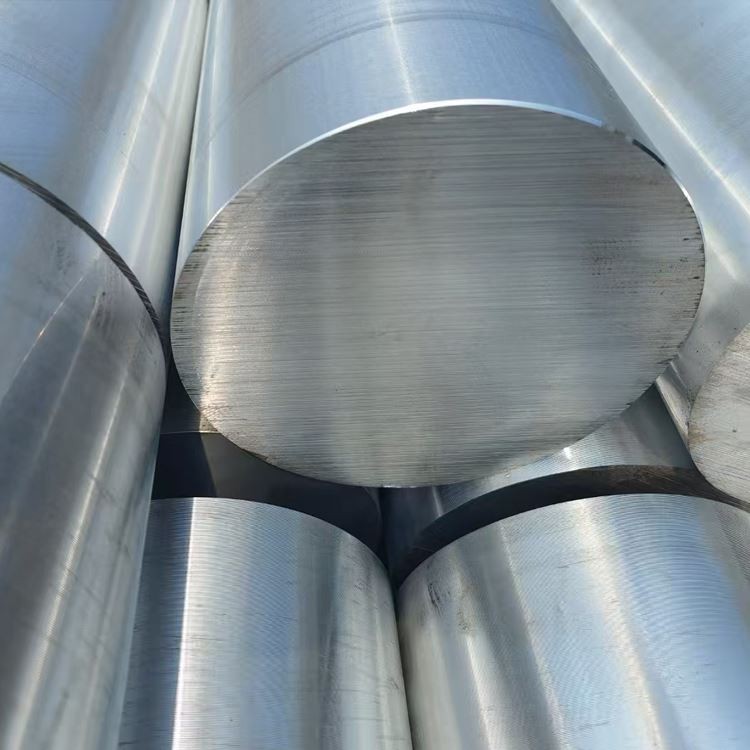


5052 Large Diameter Aluminum Bar
The 5052 large diameter aluminum bar is a robust and versatile material that offers a unique blend of physical and mechanical properties, making it ideal for numerous applications across diverse industries.
1. Material Composition & Manufacturing Process
5052 large diameter aluminum bar is a medium-strength, non-heat-treatable aluminum-magnesium alloy that offers exceptional corrosion resistance, good formability, and weldability across a wide range of diameters, making it ideal for marine, general fabrication, and structural applications:
Primary Alloying Elements:
Magnesium (Mg): 2.2-2.8% (solid solution strengthening)
Chromium (Cr): 0.15-0.35% (corrosion resistance enhancement)
Base Material:
Aluminum (Al): ≥95.7% (balance)
Controlled Impurities:
Iron (Fe): ≤0.40% max
Silicon (Si): ≤0.25% max
Copper (Cu): ≤0.10% max
Manganese (Mn): ≤0.10% max
Zinc (Zn): ≤0.10% max
Other elements: ≤0.05% each, ≤0.15% total
Premium Manufacturing Process:
Melt Preparation:
High-purity primary aluminum (99.7% minimum)
Precise alloying element additions
Melt filtration through ceramic foam filters (20-30 ppi)
Advanced degassing treatment (hydrogen < 0.15 ml/100g)
Grain refinement with Al-Ti-B master alloy
Direct-chill (DC) semi-continuous casting to produce large ingots
Homogenization:
450-480°C for 6-12 hours
Uniform temperature control: ±5°C
Controlled cooling rate: 30-50°C/hour
Hot Working (Extrusion or Forging):
Large extrusion presses: Capable of producing bars up to 300mm diameter
Or Forging: Processing ingots into bars via radial forging or die forging
Deformation temperature: 350-420°C
Ensures adequate deformation and grain refinement for optimal internal quality
Cold Working (for H Tempers):
Stretching or straightening to achieve desired hardness
Ensures uniform deformation across the large diameter
Annealing (for O Temper):
340-360°C for 1-3 hours
Controlled cooling to achieve optimal grain structure and ductility
Finishing:
Surface conditioning (e.g., peeled, ground, or precision turned)
Precision straightening
Dimensional verification
Surface quality inspection
Full manufacturing traceability with comprehensive documentation for all production steps.
2. Mechanical Properties of 5052 Large Diameter Aluminum Bar
|
Property |
O (Annealed) |
H32 |
H34 |
H38 |
Test Method |
|
Ultimate Tensile Strength |
170-215 MPa |
230-265 MPa |
255-290 MPa |
290-320 MPa |
ASTM E8 |
|
Yield Strength (0.2%) |
65-95 MPa |
160-190 MPa |
180-210 MPa |
220-250 MPa |
ASTM E8 |
|
Elongation (2 inch) |
18-30% |
12-18% |
8-14% |
5-10% |
ASTM E8 |
|
Hardness (Brinell) |
45-55 HB |
60-70 HB |
68-78 HB |
75-85 HB |
ASTM E10 |
|
Fatigue Strength (5×10⁸) |
90-110 MPa |
120-140 MPa |
130-150 MPa |
140-160 MPa |
ASTM E466 |
|
Shear Strength |
110-130 MPa |
140-160 MPa |
150-170 MPa |
165-185 MPa |
ASTM B769 |
|
Modulus of Elasticity |
70.3 GPa |
70.3 GPa |
70.3 GPa |
70.3 GPa |
ASTM E111 |
Property Distribution:
Axial vs. Radial properties: <5% variation in strength properties
Internal property variation across large diameter bars: typically less than 5%
Core to surface hardness variation: <5 HB
Property retention after welding: Excellent compared to heat-treatable alloys
3. Microstructural Characteristics
Key Microstructural Features:
Grain Structure:
Equiaxed grains in annealed condition
Elongated grains in strain-hardened tempers
ASTM grain size 5-8 (63-22μm)
Uniform grain distribution across section, especially ensured in large diameter bars through proper processing
Precipitate Distribution:
Al₁₂Mg₂Cr dispersoids: 50-200nm, uniform distribution
Al-Fe-Si intermetallics: Refined distribution
Cr-rich dispersoids: Enhances corrosion resistance
Texture Development:
Near-random orientation in O condition
Moderate deformation texture in H32/H34 tempers
Strong deformation texture in H38 temper
Special Features:
Minimal Mg₂Si precipitates at grain boundaries
Low dislocation density in O condition
Higher dislocation density in strain-hardened tempers
Excellent recrystallization control in intermediate tempers
4. Dimensional Specifications & Tolerances
|
Parameter |
Standard Range |
Precision Tolerance |
Commercial Tolerance |
Test Method |
|
Diameter |
100-500 mm |
±0.5mm up to 200mm |
±1.0mm up to 200mm |
Micrometer/Caliper |
|
±0.3% above 200mm |
±0.6% above 200mm |
|||
|
Ovality |
N/A |
50% of diameter tolerance |
75% of diameter tolerance |
Micrometer/Caliper |
|
Length |
1000-6000 mm |
±5mm |
±10mm |
Tape measure |
|
Straightness |
N/A |
0.8mm/m |
1.5mm/m |
Straightedge/Laser |
|
Surface Roughness |
N/A |
3.2 μm Ra max |
6.3 μm Ra max |
Profilometer |
|
Cut End Squareness |
N/A |
0.5° max |
1.0° max |
Protractor |
Standard Available Forms:
Large Diameter Round Bar: Diameters 100-500mm
Cut-to-length service available
Special tolerances available upon request
Precision ground or turned bars for critical applications
Custom lengths and surface finishes available
5. Temper Designations & Work Hardening Options
|
Temper Code |
Process Description |
Optimal Applications |
Key Characteristics |
|
O |
Fully annealed, softened |
Applications requiring maximum formability |
Maximum ductility, lowest strength |
|
H32 |
Quarter-hard (strain hardened) |
General purpose fabrication |
Good balance of strength and formability |
|
H34 |
Half-hard (strain hardened) |
Moderate strength applications |
Higher strength with moderate ductility |
|
H36 |
Three-quarter hard |
High-strength requirements |
High strength with reduced formability |
|
H38 |
Full-hard (strain hardened) |
Maximum strength applications |
Highest strength with minimum formability |
Temper Selection Guidance:
O: Maximum forming, bending, or drawing operations
H32: General purpose fabrication with moderate forming
H34: Applications requiring higher strength with some formability
H36/H38: Applications requiring maximum strength with minimal forming
6. Machining & Fabrication Characteristicsn
|
Operation |
Tool Material |
Recommended Parameters |
Comments |
|
Turning |
HSS, Carbide |
Vc=180-400 m/min, f=0.1-0.4 mm/rev |
Good surface finish with proper tooling |
|
Drilling |
HSS, Carbide |
Vc=60-120 m/min, f=0.15-0.35 mm/rev |
Good hole quality, minimal burring |
|
Milling |
HSS, Carbide |
Vc=180-500 m/min, fz=0.1-0.2 mm |
Use climb milling for best finish |
|
Tapping |
HSS, TiN coated |
Vc=15-30 m/min |
Good thread quality with proper lubrication |
|
Reaming |
HSS, Carbide |
Vc=40-90 m/min, f=0.2-0.5 mm/rev |
H8 tolerance achievable |
|
Sawing |
HSS, Carbide-tipped |
Vc=1000-2000 m/min |
Fine tooth pitch for best results |
Fabrication Guidance:
Machinability Rating: 70% (1100 aluminum = 100%)
Surface Finish: Very Good (Ra 0.8-3.2μm readily achievable)
Chip Formation: Medium-length chips; chip breakers beneficial
Coolant: Water-soluble emulsion preferred (5-8% concentration)
Tool Wear: Low with proper parameters
Weldability: Excellent with TIG, MIG, and resistance welding
Cold Working: Excellent formability in O condition
Hot Working: 340-420°C recommended temperature range
Cold Bending: Minimum radius 1× diameter (O temper), 1.5× diameter (H32), 2× diameter (H34/H38)
7. Corrosion Resistance & Protection Systems
|
Environment Type |
Resistance Rating |
Protection Method |
Expected Performance |
|
Industrial Atmosphere |
Excellent |
Clean surface |
15-20+ years |
|
Marine Atmosphere |
Very Good |
Clean surface |
10-15+ years |
|
Seawater Immersion |
Good |
Cathodic protection |
5-10+ years with maintenance |
|
High Humidity |
Excellent |
Standard cleaning |
15-20+ years |
|
Stress Corrosion |
Excellent |
Proper temper selection |
Superior to 6xxx/7xxx series |
|
Galvanic Corrosion |
Good |
Proper isolation |
Careful design with dissimilar metals |
Surface Protection Options:
Anodizing:
Type II (Sulfuric): 10-25μm thickness
Type III (Hard): 25-50μm thickness
Color anodizing: Excellent color retention
Mechanical Finishing:
Polishing: Enhanced appearance and reduced corrosion initiation sites
Brushed finish: Decorative and functional
Bead blasting: Uniform matte appearance
Painting Systems:
Chromate conversion coating pretreatment
Epoxy primer + polyurethane topcoat
Marine-grade systems available
Chemical Conversion:
Alodine/Iridite chromate conversion
RoHS-compliant alternatives
8. Physical Properties for Engineering Design
|
Property |
Value |
Design Consideration |
|
Density |
2.68 g/cm³ |
Weight calculation for components |
|
Melting Range |
607-649°C |
Welding parameters |
|
Thermal Conductivity |
138 W/m·K |
Thermal management design |
|
Electrical Conductivity |
35-37% IACS |
Electrical applications design |
|
Specific Heat |
880 J/kg·K |
Thermal mass calculations |
|
Thermal Expansion (CTE) |
23.8 ×10⁻⁶/K |
Thermal stress analysis |
|
Young's Modulus |
70.3 GPa |
Deflection and stiffness calculations |
|
Poisson's Ratio |
0.33 |
Structural analysis parameter |
|
Damping Capacity |
Moderate |
Vibration-sensitive applications |
Design Considerations:
Operating Temperature Range: -80°C to +200°C
Cryogenic Performance: Good (increased strength at low temperatures)
Magnetic Properties: Non-magnetic
Recyclability: 100% recyclable with high scrap value
Environmental Impact: Low carbon footprint compared to steel alternatives
9. Quality Assurance & Testing
Standard Testing Procedures:
Chemical Composition:
Optical emission spectroscopy
Verification of all major elements and impurities
Mechanical Testing:
Tensile testing (longitudinal)
Hardness testing (Brinell)
Dimensional Inspection:
Diameter measurements at multiple locations
Straightness verification
Ovality measurement
Visual Inspection:
Surface defects assessment
Finish quality verification
Specialized Testing (When Required):
Ultrasonic inspection per ASTM E114
Grain size determination (ASTM E112)
Corrosion testing (ASTM B117 salt spray)
Conductivity testing (eddy current)
Standard Certifications:
Mill Test Report (EN 10204 3.1)
Chemical analysis certification
Mechanical properties certification
Dimensional inspection report
Material traceability documentation
10. Applications & Design Considerations
Primary Applications:
Marine Components:
Large marine structural members
Ship equipment shafts, rods
Offshore platform structures
Desalination equipment parts
Energy & Chemical:
Storage tank and pressure vessel components
Heat exchanger components
Piping system flanges and connectors
Internal structures for chemical equipment
General Machinery Manufacturing:
Large machine structural frames
Drive shafts, rollers
Jigs and fixtures
Various mechanical parts
Architecture & Infrastructure:
Curtain wall structural supports
Bridge and large building connectors
Outdoor sculptures and decorative elements
Rail Transit:
Subway and train structural components
Bogie components
Electrified railway conductive components
Design Advantages:
Excellent corrosion resistance in most environments
Superior formability, especially in O temper
Excellent weldability without post-weld heat treatment
Good fatigue resistance
Attractive appearance with various finishes
Non-magnetic properties for electronic applications
Non-sparking properties for safety applications
Good machinability for complex components
Lightweight alternative to stainless steel
Moderate strength with excellent ductility
Design Limitations:
Lower strength compared to 6xxx and 7xxx series alloys
Not heat-treatable for strength enhancement
Moderate wear resistance
May experience stress relaxation under sustained loading
Not recommended for high-temperature applications above 200°C
Limited strength retention after welding in strain-hardened tempers
Economic Considerations:
Cost-effective alternative to stainless steel
Good balance of properties and cost
Lower maintenance costs in corrosive environments
Reduced finishing costs due to natural corrosion resistance
Excellent recyclability and high scrap value
Lower fabrication costs compared to harder materials
Sustainability Aspects:
100% recyclable with no loss of properties
Energy-efficient alternative to steel
Long service life reduces replacement frequency
No harmful substances or RoHS-restricted elements
Low environmental impact throughout lifecycle
High percentage of recycled content available
Material Selection Guidance:
Choose 5052 when corrosion resistance and formability are priorities
Select harder tempers (H34/H38) for increased strength requirements
Consider 6061-T6 when higher strength is required with moderate corrosion resistance
Consider 5083 for higher strength marine applications
Consider 3003 for less demanding applications with cost constraints
Processing Recommendations:
Allow for springback in forming operations (increases with harder tempers)
Use appropriate radius in bending operations based on temper
Employ proper cleaning procedures before welding
Hot Tags: 5052 large diameter aluminum bar, China 5052 large diameter aluminum bar manufacturers, suppliers, factory, 7075 aluminum forging, 5052 aluminum forged bar, helical gear aluminum forging rod, large diameter aluminum round bar, turbine aluminum forging rod, automatic transmission aluminum forging bar


Send Inquiry
