


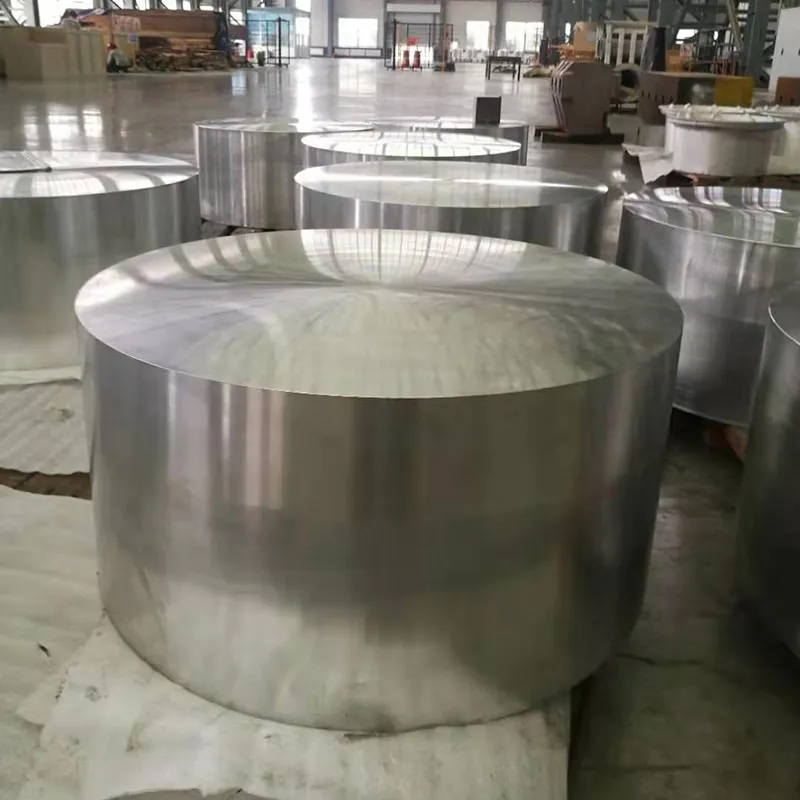

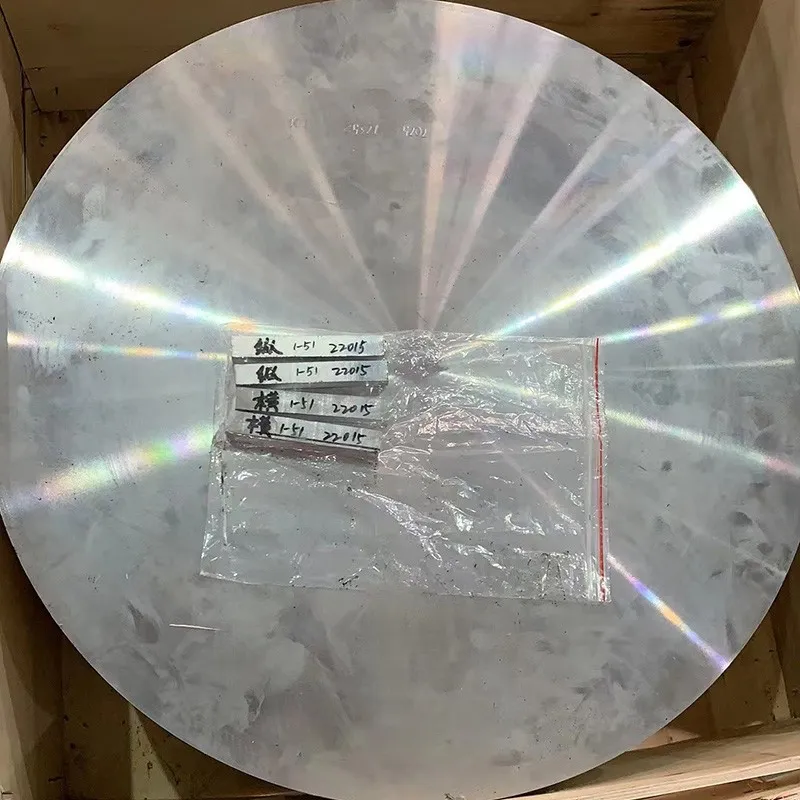
7075 Aluminum Alloy Forged Disc
7075 aluminum forging cake plays an important role in various fields such as aerospace, automotive manufacturing, and mold processing due to its excellent characteristics of high strength, high hardness, good toughness, and corrosion resistance.
1. Material Composition & Manufacturing Process
7075 aluminum alloy forged discs represent the pinnacle of aerospace-grade aluminum components, offering exceptional strength, fatigue resistance, and stress distribution for critical rotating and structural applications:
Primary Alloying Elements:
Zinc (Zn): 5.1-6.1% (principal strengthening element)
Magnesium (Mg): 2.1-2.9% (enhances precipitation hardening)
Copper (Cu): 1.2-2.0% (improves strength and stress resistance)
Chromium (Cr): 0.18-0.28% (corrosion resistance and grain structure control)
Base Material:
Aluminum (Al): ≥87.1% (balance)
Controlled Impurities:
Iron (Fe): ≤0.50% max
Silicon (Si): ≤0.40% max
Manganese (Mn): ≤0.30% max
Titanium (Ti): ≤0.20% max
Other elements: ≤0.05% each, ≤0.15% total
Premium Forging Process:
Melt Preparation:
Primary high-purity aluminum (99.7% minimum)
Precise alloying element additions with ±0.1% tolerance
Advanced filtration through ceramic foam filters (30-40 ppi)
SNIF degassing treatment (hydrogen < 0.10 ml/100g)
Grain refinement with Al-Ti-B master alloy
Direct-chill (DC) semi-continuous casting
Homogenization:
460-480°C for 24-36 hours
Uniform temperature control: ±5°C
Controlled cooling rate: 15-25°C/hour
Dissolution of coarse intermetallics
Microsegregation elimination
Billet Preparation:
Surface conditioning (scalping)
Ultrasonic inspection (100% volumetric)
Preheating: 380-400°C for uniform temperature
Forging Sequence:
Open-die preforming: 380-410°C
Closed-die finish forging: 360-390°C
Hydraulic press capacity: 2,000-10,000 tons
Computer-controlled ram speed and pressure
Multi-stage forging for optimal grain flow
Minimum reduction ratio: 3:1
Solution Heat Treatment:
465-485°C for 1-4 hours (thickness dependent)
Temperature uniformity: ±3°C
Rapid transfer to quenching medium (<10 seconds)
Quenching:
Polymer-enhanced water quenchant
Controlled agitation for uniform cooling
Minimum cooling rate: 100°C/sec at surface
Stress Relief:
Controlled stretching (1-3% plastic deformation)
Alternatively, compressive stress relief
Artificial Aging (T6/T73 Tempers):
T6: 120°C for 24 hours
T73: Two-stage aging (107°C for 6-8 hours, followed by 163-177°C for 24-30 hours)
Temperature uniformity: ±3°C
Final Processing:
Precision machining to near-net shape
Surface treatment
Nondestructive testing
Dimensional verification
Full process traceability with computerized quality monitoring at all stages.
2. Mechanical Properties of 7075 Forged Discs
|
Property |
T6 Temper |
T73 Temper |
T7351 Temper |
Test Method |
|
Ultimate Tensile Strength |
570-595 MPa |
505-545 MPa |
510-550 MPa |
ASTM E8 |
|
Yield Strength (0.2%) |
495-525 MPa |
425-470 MPa |
435-480 MPa |
ASTM E8 |
|
Elongation (2 inch) |
8-12% |
10-14% |
10-14% |
ASTM E8 |
|
Hardness (Brinell) |
150-165 HB |
140-155 HB |
140-155 HB |
ASTM E10 |
|
Fracture Toughness (K1C) |
24-29 MPa√m |
31-37 MPa√m |
29-35 MPa√m |
ASTM E399 |
|
Fatigue Strength (10⁷ Cycles) |
160-190 MPa |
145-170 MPa |
150-175 MPa |
ASTM E466 |
|
Shear Strength |
330-350 MPa |
290-315 MPa |
295-325 MPa |
ASTM B769 |
|
Compressive Yield Strength |
520-550 MPa |
455-495 MPa |
465-505 MPa |
ASTM E9 |
|
Modulus of Elasticity |
71.7 GPa |
71.7 GPa |
71.7 GPa |
ASTM E111 |
Property Distribution:
Radial vs. Tangential: <5% variation in strength properties
Surface to center variation: <8% for discs up to 150mm thickness
Minimum properties guaranteed in all critical orientations
Superior isotropy compared to rolled plate or extruded bar
Stress corrosion cracking resistance (T73): >200 MPa threshold stress
3. Microstructural Characteristics
Key Microstructural Features:
Grain Structure:
Fine, equiaxed recrystallized grains
ASTM grain size 6-8 (45-22μm)
Uniform grain distribution across section
Controlled grain flow pattern following forging contours
Precipitate Distribution:
MgZn₂ (η/η') strengthening precipitates: 5-15nm
CuMgAl₂ (S-phase) precipitates: Uniformly distributed
Al₇Cu₂Fe intermetallics: Controlled size and distribution
Al₁₂Mg₂Cr dispersoids: 50-200nm for recrystallization control
Texture Development:
Balanced texture with minimized directionality
Forging-induced fiber texture optimized for isotropic properties
Special fiber texture tailored for high fatigue resistance
Special Features:
Minimal precipitate-free zones (PFZs) at grain boundaries
Controlled distribution of coarse intermetallics
Fine dispersoid distribution for recrystallization control
Optimized grain boundary character distribution
4. Dimensional Specifications & Tolerances
|
Parameter |
Standard Range |
Precision Tolerance |
Commercial Tolerance |
Test Method |
|
Diameter |
50-1500 mm |
±0.5mm up to 150mm |
±1.0mm up to 150mm |
CMM |
|
±0.3% above 150mm |
±0.6% above 150mm |
|||
|
Thickness |
15-300 mm |
±0.5mm up to 50mm |
±1.0mm up to 50mm |
Micrometer |
|
±1.0% above 50mm |
±1.5% above 50mm |
|||
|
Flatness |
N/A |
0.5mm/m |
1.0mm/m |
Dial gauge |
|
Surface Roughness |
N/A |
3.2 μm Ra max |
6.3 μm Ra max |
Profilometer |
|
Parallelism |
N/A |
0.5mm |
1.0mm |
CMM |
|
Concentricity |
N/A |
0.5mm |
1.0mm |
CMM |
|
Bolt Circle Diameter |
As specified |
±0.2mm |
±0.5mm |
CMM |
Standard Available Forms:
Diameters: 50mm to 1500mm
Thickness: 15mm to 300mm
Profile variations: Flat, stepped, contoured
Surface conditions: As-forged, machined, heat-treated
Near-net shape capabilities for reduced machining
Custom forgings with integral features (bosses, lugs, etc.)
5. Temper Designations & Heat Treatment Options
|
Temper Code |
Process Description |
Optimal Applications |
Key Characteristics |
|
T6 |
Solution heat treated and artificially aged |
High-strength applications |
Maximum strength and hardness |
|
T651 |
T6 + stress relieved by stretching |
Critical structural components |
Improved stress distribution |
|
T73 |
Solution heat treated and overaged |
Stress corrosion critical applications |
Superior SCC resistance with reduced strength |
|
T7351 |
T73 + stress relieved by stretching |
Critical aerospace components |
Excellent balance of properties |
|
T76 |
Modified overaging treatment |
Balanced property requirements |
Compromise between T6 and T73 |
Temper Selection Guidance:
T6/T651: Maximum strength and fatigue resistance requirements
T73/T7351: Stress-corrosion critical applications
T76: Balanced properties for general aerospace applications
6. Machining & Fabrication Characteristics
|
Operation |
Tool Material |
Recommended Parameters |
Comments |
|
Turning |
Carbide, PCD |
Vc=150-300 m/min, f=0.1-0.3 mm/rev |
Sharp tools essential |
|
Face Milling |
Carbide, PCD |
Vc=200-400 m/min, fz=0.1-0.2 mm/tooth |
High-positive rake angles |
|
Drilling |
Carbide, TiAlN coated |
Vc=80-120 m/min, f=0.15-0.30 mm/rev |
Through-coolant drills preferred |
|
Tapping |
HSS-E-PM, TiCN coated |
Vc=15-25 m/min |
Form taps for critical threads |
|
Reaming |
Carbide, PCD |
Vc=60-90 m/min, f=0.2-0.4 mm/rev |
H7 tolerance achievable |
|
Boring |
Carbide, PCD |
Vc=200-300 m/min, f=0.1-0.3 mm/rev |
Balanced boring bars for vibration control |
Fabrication Guidance:
Machinability Rating: 70% (1100 aluminum = 100%)
Surface Finish: Good (Ra 0.8-3.2μm achievable)
Chip Formation: Short to medium chips with proper tooling
Coolant: Water-soluble emulsion (8-10% concentration)
Tool Wear: Moderate with proper parameters
Cutting Forces: Higher than other aluminum alloys
Material Removal Rate: Up to 2000 cm³/min possible with robust setups
Residual Stress Control: Critical for aerospace components
Thin-wall Machining: Careful approach to minimize distortion
Heat Generation: Monitor to avoid localized overheating
7. Corrosion Resistance & Protection Systems
|
Environment Type |
Resistance Rating |
Protection Method |
Expected Performance |
|
Industrial Atmosphere |
Fair |
Anodizing + paint |
3-5 years with maintenance |
|
Marine Environment |
Poor |
Anodizing + chromate + paint |
2-3 years with maintenance |
|
High Humidity |
Fair |
Anodizing Type II |
1-2 years without additional protection |
|
Stress Corrosion |
Poor in T6, Good in T73 |
Proper temper selection |
Application specific |
|
Exfoliation |
Poor in T6, Good in T73 |
Proper temper selection + protection |
Critical for marine applications |
|
Galvanic Corrosion |
Poor with carbon steels |
Isolation or sacrificial protection |
Requires careful design |
Surface Protection Options:
Anodizing:
Type I (Chromic): 2-8μm (aerospace grade)
Type II (Sulfuric): 10-25μm (general purpose)
Type III (Hard): 25-75μm (wear resistance)
Sealing options: Hot water, dichromate, nickel acetate
Conversion Coatings:
Chromate per MIL-DTL-5541 Class 1A
Non-chromium alternatives for environmental compliance
Painting Systems:
Epoxy primer + polyurethane topcoat
Aerospace-qualified systems per OEM specifications
Advanced Protection:
Sol-gel pretreatments
Plasma electrolytic oxidation
Ion vapor deposition (IVD) aluminum coating
8. Physical Properties for Engineering Design
|
Property |
Value |
Design Consideration |
|
Density |
2.81 g/cm³ |
Weight calculation for rotating components |
|
Melting Range |
477-635°C |
Heat treatment limitations |
|
Thermal Conductivity |
130-150 W/m·K |
Thermal gradient analysis |
|
Electrical Conductivity |
33-40% IACS |
Electrical applications design |
|
Specific Heat |
860 J/kg·K |
Thermal mass calculations |
|
Thermal Expansion (CTE) |
23.4 ×10⁻⁶/K |
Thermal stress analysis |
|
Young's Modulus |
71.7 GPa |
Deflection and stiffness calculations |
|
Poisson's Ratio |
0.33 |
Structural analysis parameter |
|
Damping Capacity |
Low |
Vibration analysis for rotating components |
Design Considerations:
Operating Temperature Range: -60°C to +120°C
Property Retention: Excellent below 100°C, gradual degradation above
Stress Relaxation: Minimal below 100°C
Fatigue Life: Superior due to forged microstructure
Notch Sensitivity: Moderate (improved in T73 temper)
Cryogenic Performance: Good strength retention at low temperatures
Spin Testing Requirements: Typically 115-120% of maximum design speed
9. Quality Assurance & Testing
Standard Testing Procedures:
Chemical Composition:
Optical emission spectroscopy
X-ray fluorescence analysis
Verification of all major elements and impurities
Mechanical Testing:
Tensile testing (radial, tangential, and axial directions)
Hardness testing (Brinell, multiple locations)
Impact testing (when required)
Fatigue testing (for critical applications)
Nondestructive Testing:
Ultrasonic inspection (100% volumetric)
Penetrant inspection (100% surface)
Eddy current testing (surface and near-surface)
Radiographic testing (when required)
Microstructural Analysis:
Grain size determination
Intermetallic particle evaluation
Precipitate distribution
Fiber flow pattern verification
Dimensional Inspection:
CMM (Coordinate Measuring Machine) verification
Geometric dimensioning and tolerancing (GD&T)
Runout and flatness measurements
Profile verification for contoured discs
Standard Certifications:
Material Test Report (EN 10204 3.1)
Chemical analysis certification
Mechanical properties certification
Heat treatment certification
Nondestructive testing certification
Traceable to aerospace standards (AMS, ASTM, etc.)
10. Applications & Design Considerations
Primary Applications:
Aerospace Components:
Aircraft landing gear components
Aero-engine turbine discs and fan discs
Structural fittings and brackets
Aircraft structural frames and spar fittings
Defense Applications:
Missile components
Critical structural elements for weapon systems
Armored vehicle transmission components
High-stress parts for tactical equipment
High-Performance Automotive:
Racing wheel hubs and drivetrain components
Critical suspension system components
Brake disc hats
Aerospace-grade fastener bases
Industrial Equipment:
High-stress couplings for heavy machinery
Compressor impellers
High-pressure parts for pumps and valves
Test equipment fixtures
Design Advantages:
Exceptional strength-to-weight ratio
Superior fatigue life and damage tolerance
Optimized grain flow and microstructure from forging process
High reliability and consistency
Good machinability
Excellent dimensional stability
Reliable performance in high-stress applications
Extensive material database for engineering design
Customizable to specific requirements
Design Limitations:
Relatively higher cost
Relatively poorer corrosion resistance in T6 temper
Not suitable for welding applications
Higher sensitivity to notches and surface defects
Limited formability
Not recommended for prolonged use above 120°C
Requires specialized forging and heat treatment equipment
Longer manufacturing lead times
Hot Tags: 7075 aluminum alloy forged disc, China 7075 aluminum alloy forged disc manufacturers, suppliers, factory, seal aluminum forging bar, rotary seal aluminum forging rod, ball bearing aluminum forging rod, 6061 large diameter aluminum bar, pipe flange aluminum forging rod, rim aluminum forging rod


Send Inquiry
