


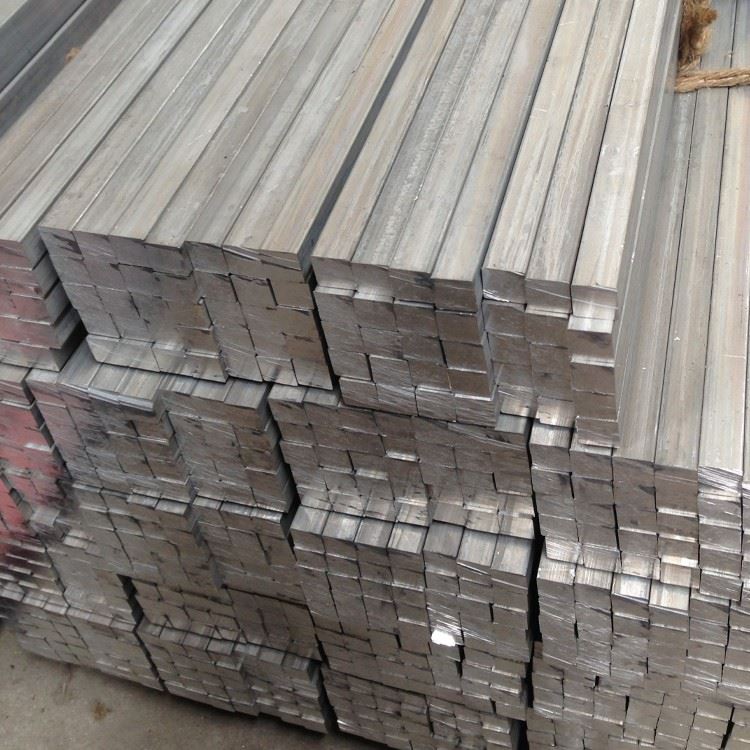
2024 Aluminum Bar
2024 aluminum square rod is often used as the elastic material for medium and small range weighing sensors. Its low elastic modulus characteristic enables the sensor to produce sufficient deformation when subjected to force, thereby accurately measuring and transmitting force or pressure signals.
1. Material Composition & Manufacturing Process
2024 aluminum alloy (AMS 4120, ASTM B211) is a high-strength aircraft-grade aluminum-copper alloy prized for its excellent strength-to-weight ratio, superior machinability, and good fatigue performance. The bar stock configuration offers optimized properties for critical structural components:
Primary Alloying Elements:
Copper (Cu): 3.8-4.9% (primary strengthening element)
Magnesium (Mg): 1.2-1.8% (precipitation hardening)
Manganese (Mn): 0.3-0.9% (grain structure control)
Silicon (Si): ≤0.5% (improves castability)
Base Material:
Aluminum (Al): ≥90.7% (balance)
Controlled Impurities:
Iron (Fe): ≤0.5% max
Zinc (Zn): ≤0.25% max
Titanium (Ti): ≤0.15% max
Chromium (Cr): ≤0.10% max
Other elements: ≤0.05% each, ≤0.15% total
Premium Manufacturing Process:
Billet Preparation:
Primary high-purity aluminum (99.7% minimum)
Precise alloying element additions
Filtration through ceramic foam filters
Degassing treatment (hydrogen < 0.15 ml/100g)
Direct-chill semi-continuous casting
Homogenization:
480-500°C for 12-24 hours
Uniform temperature control: ±5°C
Microstructural equilibration
Cu-rich phase dissolution
Extrusion:
Preheating to 370-400°C
Lubrication optimization
Computerized extrusion force monitoring
Exit temperature control: 450-480°C
Cooling rate optimization for property development
Straightening within 4mm/m
Solution Heat Treatment:
490-500°C for 1 hour (diameter-dependent)
Temperature uniformity: ±3°C
Rapid transfer to quenching medium
Quenching:
Cold water (5-30°C)
Agitation for uniform cooling
Maximum transfer time: 15 seconds
Minimum cooling rate: 100°C/sec at surface
Cold Straightening:
Hydraulic press straightening
Maximum 1-2% cold work
Residual stress minimization
Artificial Aging:
T3: Natural aging at room temperature
T351: Stress relief + natural aging
T4: Solution heat treated + natural aging
T6: Artificial aging at 190°C for 12 hours
Full process traceability with lot-specific quality documentation.
2. Mechanical Properties of 2024 Aluminum Bar
|
Property |
T351 (min) |
T351 (typical) |
T6 (min) |
T6 (typical) |
Test Method |
|
Ultimate Tensile Strength |
425 MPa |
440-470 MPa |
440 MPa |
460-490 MPa |
ASTM E8 |
|
Yield Strength (0.2%) |
290 MPa |
310-345 MPa |
345 MPa |
360-400 MPa |
ASTM E8 |
|
Elongation (2 inch) |
10% |
12-17% |
5% |
6-10% |
ASTM E8 |
|
Hardness (Brinell) |
110 HB |
115-125 HB |
120 HB |
125-135 HB |
ASTM E10 |
|
Fatigue Strength (5×10⁸) |
130 MPa |
140-150 MPa |
120 MPa |
125-140 MPa |
ASTM E466 |
|
Shear Strength |
270 MPa |
285-300 MPa |
280 MPa |
290-310 MPa |
ASTM B769 |
|
Fracture Toughness (K₁c) |
26 MPa√m |
28-32 MPa√m |
20 MPa√m |
22-25 MPa√m |
ASTM E399 |
|
Modulus of Elasticity |
73.1 GPa |
73.1 GPa |
73.1 GPa |
73.1 GPa |
ASTM E111 |
Property Distribution:
Longitudinal to transverse property ratio: 1.00:0.85-0.90
Variation across diameter: <5% for bars up to 100mm
Core to surface hardness variation: <8 HB
Property retention after thermal exposure: Excellent below 100°C
3. Microstructural Characteristics
Key Microstructural Features:
Grain Structure:
Elongated grains in extrusion direction
ASTM grain size 5-7 (50-70μm)
Aspect ratio: 2:1 to 5:1
Subgrain development in T351 temper
Precipitate Distribution:
Al₂Cu (θ/θ') strengthening precipitates: 5-50nm
Al₂CuMg (S-phase) precipitates
Al₁₂Mn₃Si dispersoids: 50-200nm
Al₇Cu₂Fe intermetallics: Controlled size and distribution
Texture Development:
Strong <111> and <100> fiber textures
Deformation texture retained after heat treatment
Texture intensity: 3-8× random
Special Features:
Recrystallization controlled by Mn dispersoids
Natural aging involves GP zone formation
T6 temper: θ' (Al₂Cu) precipitate dominance
Precipitate-free zones near grain boundaries: <50nm
4. Dimensional Specifications & Tolerances
|
Parameter |
Standard Range |
Precision Tolerance |
Commercial Tolerance |
Test Method |
|
Diameter (Round) |
10-300 mm |
±0.15mm up to 30mm |
±0.25mm up to 30mm |
Micrometer |
|
±0.5% above 30mm |
±1.0% above 30mm |
|||
|
Width (Rectangle) |
10-250 mm |
±0.20mm up to 50mm |
±0.30mm up to 50mm |
Caliper |
|
±0.4% above 50mm |
±0.8% above 50mm |
|||
|
Length |
2000-6000 mm |
±3mm |
±6mm |
Tape measure |
|
Straightness |
N/A |
0.5mm/m |
1.0mm/m |
Straightedge |
|
Twist (Rectangular) |
N/A |
2° max per meter |
4° max per meter |
Protractor |
|
Surface Roughness |
N/A |
3.2 μm Ra max |
6.3 μm Ra max |
Profilometer |
Standard Available Forms:
Round Bar: Diameters 10-300mm
Hexagonal Bar: Across flats 10-100mm
Square Bar: Side dimensions 10-150mm
Rectangular Bar: Width up to 250mm, thickness from 10mm
Cut-to-length service available
5. Temper Designations & Heat Treatment Options
|
Temper Code |
Process Description |
Optimal Applications |
Key Characteristics |
|
T351 |
Solution heat treated, stress relieved by stretching (1-3%), naturally aged |
Aerospace structural components, machined parts |
Excellent machinability, good strength-toughness balance |
|
T4/T451 |
Solution heat treated, naturally aged |
Parts requiring maximum formability |
Best formability, moderate strength |
|
T6/T651 |
Solution heat treated, artificially aged |
Maximum strength applications |
Highest strength, reduced ductility |
|
T861 |
Solution heat treated, cold worked, artificially aged |
Highly stressed components |
High strength with good SCC resistance |
|
T3 |
Solution heat treated, cold worked, naturally aged |
General purpose applications |
Good balance of properties |
Temper Selection Guidance:
T351: Optimal for parts machined from bar stock
T6: When maximum strength is required
T4: When post-forming operations are needed
T861: For components exposed to high stress in corrosive environments
6. Machining & Fabrication Characteristics
|
Operation |
Tool Material |
Recommended Parameters |
Comments |
|
Turning |
Carbide, PCD |
Vc=300-600 m/min, f=0.1-0.3 mm/rev |
Excellent chip breaking |
|
Drilling |
HSS-Co, Carbide |
Vc=70-120 m/min, f=0.2-0.4 mm/rev |
Good hole quality |
|
Milling |
Carbide, PCD |
Vc=300-700 m/min, fz=0.1-0.3 mm |
Climb milling preferred |
|
Tapping |
HSS-E, TiN coated |
Vc=15-25 m/min |
Excellent thread quality |
|
Reaming |
Carbide, PCD |
Vc=40-80 m/min, f=0.2-0.5 mm/rev |
H7 tolerance achievable |
|
Deep Drilling |
Carbide, HSS-Co |
Vc=60-90 m/min, pecking cycle |
Excellent chip evacuation |
Fabrication Guidance:
Machinability Rating: 70% (1100 aluminum = 100%)
Surface Finish: Excellent (Ra 0.8-3.2μm achievable)
Chip Formation: Short to medium chips
Coolant: Water-soluble emulsion preferred (8-10% concentration)
Tool Wear: Moderate with proper parameters
Burr Formation: Minimal with sharp tooling
Cold Working: Good formability in T4 condition
Hot Working: 350-450°C recommended temperature range
Weldability: Limited (pre-welding cleaning critical)
7. Corrosion Resistance & Protection Systems
|
Environment Type |
Resistance Rating |
Protection Method |
Expected Performance |
|
Industrial Atmosphere |
Moderate |
Anodizing + paint |
5-10 years with maintenance |
|
Marine Environment |
Poor |
Anodizing + chromate + paint |
3-5 years with maintenance |
|
High Humidity |
Fair |
Anodizing Type II |
2-3 years without additional protection |
|
Stress Corrosion |
Poor in T351, Better in T861 |
Shot peening + protection |
Application specific |
|
Exfoliation |
Fair to Good |
Proper heat treatment |
T7x tempers preferred for critical apps |
Surface Protection Options:
Anodizing:
Type II (Sulfuric): 10-25μm thickness
Type III (Hard): 25-75μm thickness
Chromic: 2-7μm (aerospace applications)
Conversion Coatings:
Chromate per MIL-DTL-5541 Class 1A
Non-chromium alternatives available
Painting Systems:
Epoxy primer + polyurethane topcoat
Aerospace-qualified systems available
Mechanical Protection:
Shot peening for enhanced fatigue and SCC resistance
Burnishing for improved surface finish
8. Physical Properties for Engineering Design
|
Property |
Value |
Design Consideration |
|
Density |
2.78 g/cm³ |
Weight calculation for components |
|
Melting Range |
502-638°C |
Heat treatment limitations |
|
Thermal Conductivity |
120-150 W/m·K |
Thermal management design |
|
Electrical Conductivity |
30-40% IACS |
Electrical applications design |
|
Specific Heat |
875 J/kg·K |
Thermal mass calculations |
|
Thermal Expansion (CTE) |
23.2 ×10⁻⁶/K |
Thermal stress analysis |
|
Young's Modulus |
73.1 GPa |
Deflection and stiffness calculations |
|
Poisson's Ratio |
0.33 |
Structural analysis parameter |
|
Machinability Rating |
70% (1100=100%) |
Manufacturing planning |
Design Considerations:
Operating Temperature Range: -80°C to +120°C
Property Retention: Excellent below 100°C
Electrical Conductivity: 30% IACS (T3), 40% IACS (T6)
Stress Relaxation: Minimal below 100°C
Magnetic Properties: Non-magnetic
Damping Capacity: Low (typical of aluminum alloys)
9. Quality Assurance & Testing
Standard Testing Procedures:
Chemical Composition:
Optical emission spectroscopy
Verification of all major elements and impurities
Mechanical Testing:
Tensile testing (longitudinal and transverse)
Hardness testing (Brinell or Rockwell)
Electrical conductivity for temper verification
Dimensional Inspection:
Diameter/dimensions at multiple locations
Straightness verification
Surface finish measurement
Visual Inspection:
Surface defects assessment
Finish quality verification
Specialized Testing (When Required):
Ultrasonic inspection per AMS-STD-2154
Penetrant inspection
Grain flow evaluation
Microstructural examination
Standard Certifications:
Mill Test Report (EN 10204 3.1)
Chemical analysis certification
Mechanical properties certification
Heat treatment certification
Dimensional inspection report
10. Applications & Design Considerations
Primary Applications:
Aircraft landing gear components
Aerospace fittings and connectors
High-strength structural elements
Critical automotive components
Defense industry applications
Precision machine parts
Mold tooling components
High-performance bolts and fasteners
Hydraulic system components
Connecting rods and drive shafts
Design Advantages:
Excellent strength-to-weight ratio
Superior machinability for complex parts
Good fatigue performance
High fracture toughness in T351 condition
Dimensional stability after machining
Suitable for critical load-bearing applications
Good wear resistance with appropriate surface treatments
Proven history in aerospace applications
Predictable and consistent properties
Widely available in various sizes and forms
Hot Tags: 2024 aluminum bar, China 2024 aluminum bar manufacturers, suppliers, factory, aluminum bar that is easy to clean, aluminum bar that is resistant to fading, 6063 aluminum flat bar, aluminum bar that is resistant to cracking, aluminum bar that is resistant to impact, aluminum extruded 7075


Send Inquiry
