


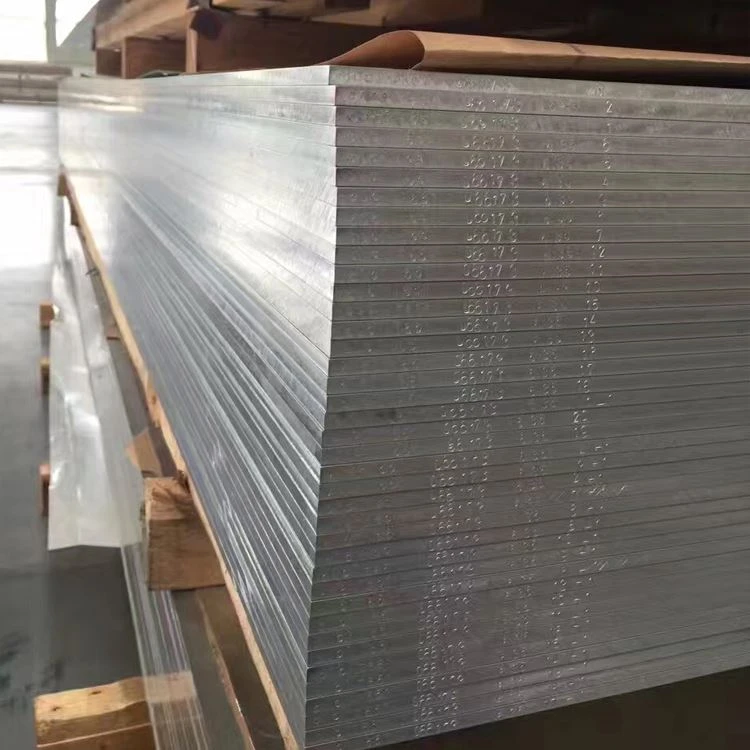

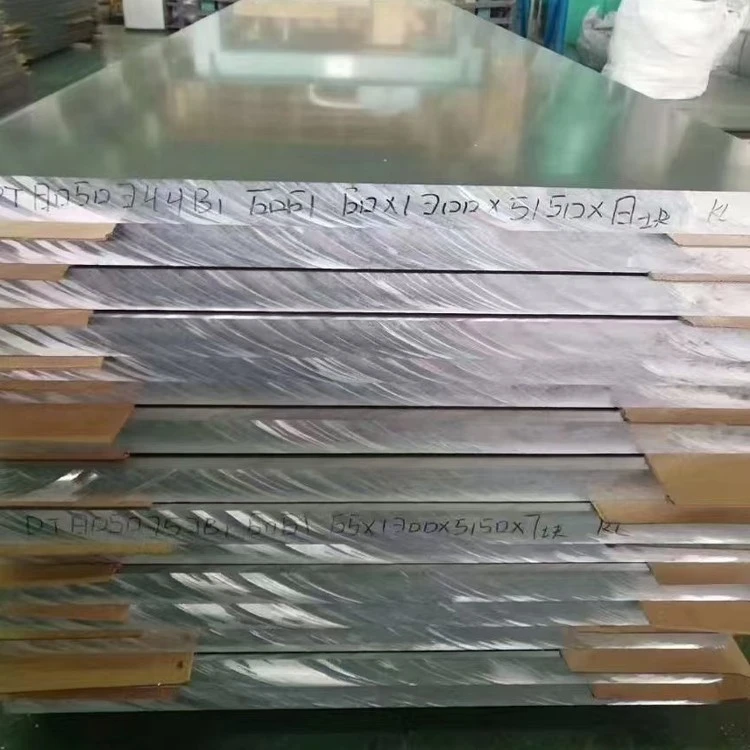
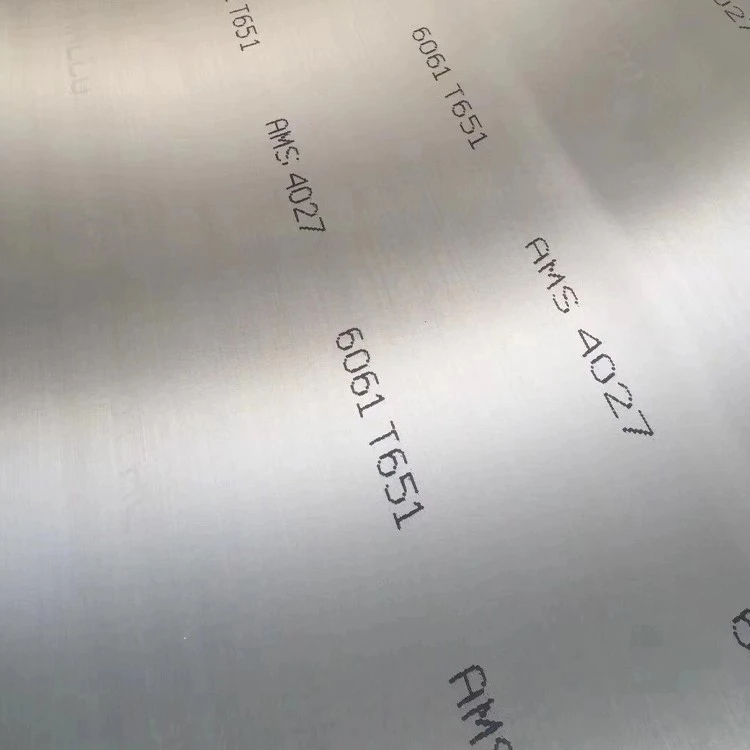
6061 T6 Aluminum Plate
6061 aluminum alloy plate is an alloy steel plate material with good corrosion resistance, excellent weldability, good cold workability, and moderate strength.
1. Material Composition & Manufacturing Process
6061 aluminum alloy (ASTM B209, AMS QQ-A-250/11) is a heat-treatable Al-Mg-Si alloy optimized for high strength-to-weight ratio applications. The T6 temper provides optimal mechanical properties through solution heat treatment and artificial aging:
Alloy Chemistry:
Magnesium (Mg): 0.8-1.2% (solution strengthening)
Silicon (Si): 0.4-0.8% (precipitation hardening)
Copper (Cu): 0.15-0.40% (enhanced machining)
Chromium (Cr): 0.04-0.35% (grain control)
Iron (Fe): ≤0.70% max
Base Material:
Aluminum (Al): ≥97.5% (balance)
Controlled Impurities:
Zinc (Zn): ≤0.25% max
Titanium (Ti): ≤0.15% max
Manganese (Mn): ≤0.15% max
Thermomechanical Processing:
Direct Chill Casting: 680-710°C molten temperature
Homogenization: 540-560°C for 8-12 hours
Hot Rolling: Reduction at 430-490°C
Cold Rolling: Final gauge reduction (15-25%)
Solution Heat Treatment: 530°C ±5°C for 1-2 hours
Water Quenching: Cooling rate >200°C/min
Artificial Aging: 160-180°C for 8-12 hours
Certified to AMS 4025 and EN 485 standards with full traceability from billet to finished plate.
2. Mechanical Properties of T6 Temper State
|
Property |
Minimum |
Typical |
Test Standard |
Notes |
|
Ultimate Tensile Strength |
260 MPa |
310 MPa |
ASTM B557 |
Superior to T651 temper |
|
Yield Strength (Rp0.2) |
240 MPa |
275 MPa |
ASTM B557 |
95% retention at 100°C |
|
Elongation (50mm gauge) |
10% |
12-17% |
ASTM B557 |
Higher in thicker sections |
|
Shear Strength |
170 MPa |
205 MPa |
ASTM B769 |
85% of tensile strength |
|
Bearing Strength |
480 MPa |
530 MPa |
ASTM E238 |
e/D=2.0 condition |
|
Fatigue Strength (10⁷) |
95 MPa |
110 MPa |
ASTM E466 |
R=-1 condition |
|
Hardness (Brinell) |
95 HB |
100 HB |
ASTM E10 |
Consistent through plate |
|
Impact Toughness (Charpy) |
14 J |
18 J |
ASTM E23 |
At room temperature |
|
Fracture Toughness (K₁c) |
29 MPa√m |
34 MPa√m |
ASTM E399 |
T-L orientation |
3. T6 Heat Treatment & Microstructure Control
Precision Thermal Processing:
Solution Treatment:
Temperature: 529-533°C (±3°C control)
Soak Time: 60 minutes minimum per inch thickness
Atmosphere: Protective nitrogen environment
Quenching Process:
Transfer Time: <15 seconds furnace-to-quench
Water Temperature: 20-40°C (chiller controlled)
Agitation: Turbulent flow >1.5 m/sec
Aging Treatment:
Single Stage: 165-175°C for 8-10 hours
Double Stage: 120°C/5hr + 175°C/8hr (special)
Microstructural Characteristics:
Grain Size: ASTM 6-7 (50-100μm)
Precipitate Phases:
β" needle precipitates (5-50nm length)
β' rod-like phases (100-500nm)
Secondary Precipitates:
Al-Fe-Si dispersoids
Mg₂Si hardening phases
Dislocation Density: 4-6×10¹⁰/cm²
Recrystallization Fraction: 75-90%
4. Dimensional Specifications & Tolerances
|
Parameter |
Standard Range |
Commercial Tolerance |
Precision Tolerance |
|
Thickness |
3-150 mm |
±0.5-1.0% |
±0.1-0.3% |
|
Width |
1000-3000 mm |
±10 mm |
±2 mm |
|
Length |
2000-12000 mm |
+20/-0 mm |
+5/-0 mm |
|
Flatness |
N/A |
ASTM B209 Class |
1/4 commercial spec |
|
Surface Roughness |
N/A |
0.8-1.5 μm Ra |
0.2-0.4 μm Ra |
|
Squareness |
N/A |
≤2 mm/1000 mm |
≤0.5 mm/1000 mm |
Special Capabilities:
Oversize Plates: Up to 4500mm wide × 18000mm long
Ultrasonic Calibration: ASTM B594 Level A
Edge Conditions: Plasma cut, machined, or mill finish
Weight Calculation Formula: Thickness (mm) × Width (m) × Length (m) × 2.703 = Weight (kg)
5. Corrosion Resistance & Surface Protection
|
Environment |
Performance |
Corrosion Rate |
Protection Method |
|
Industrial Atmospher |
Good |
0.005-0.02 mm/yr |
Chromic acid anodizing |
|
Marine Environments |
Fair |
0.01-0.03 mm/yr |
Fluoropolymer coating |
|
Fresh Water |
Excellent |
Negligible |
PTFE impregnation |
|
Chemical Exposure |
Varies |
Acid-dependent |
PVDF coating |
|
Stress Corrosion |
Good |
SCC threshold>150MPa |
Special tempering |
Surface Enhancement Options:
Anodizing:
Type II: 5-25μm thickness
Type III: 25-75μm hardness
Chemical Conversion:
Chromate (Class 1A)
Chromium-free alternatives
Organic Finishes:
Powder coating (60-120μm)
Liquid coatings (EP, PU, Acrylic)
Embossing Options:
Diamond plate pattern
Linear tread patterns
6. Machining & Fabrication Performance
|
Operation |
Tool Material |
Recommended Parameters |
Surface Quality |
|
Milling |
Carbide inserts |
Vc=500-800 m/min, fz=0.1-0.3 mm |
Ra 0.8-1.6 μm |
|
Drilling |
HSS-Co drills |
Vc=50-80 m/min, fn=0.1 mm/rev |
Hole tolerance H9 |
|
Turning |
PCD tools |
Vc=800-1200 m/min |
Ra 0.4-0.8 μm |
|
Tapping |
Spiral taps |
Vc=10-15 m/min |
6H thread quality |
|
Waterjet Cutting |
3800 bar abrasive |
Speed=150-300 mm/min |
±0.15 mm precision |
Forming Characteristics:
Bend Radius (Minimum):
90° bending: 1.5T (T=thickness)
Cold forming: 2.0T minimum
Elastic Springback: 1-3° compensation required
Stretch Formability:
Maximum elongation: 8-10%
Strain hardening exponent: 0.08-0.12
7. Welding & Joining Technologies
Recommended Welding Processes:
Gas Metal Arc Welding (GMAW):
Wire: ER4043 or ER5356
Parameters: 20-24V, 160-220A
Gas: Argon (100%) or Ar/He mix
Tungsten Inert Gas (GTAW):
Electrode: Ceriated tungsten
Amperage: 150-300A DCEN
Friction Stir Welding (FSW):
Tool rotation: 600-1200 RPM
Travel speed: 150-350 mm/min
Post-Weld Heat Treatment:
Solution heat treatment: Not recommended
Aging Only: 165°C for 4-6 hours
Natural Aging: T4 condition restored after 4 days
8. Physical Properties for Engineering Applications
|
Property |
Value |
Application Significance |
|
Density |
2.70 g/cm³ |
Lightweight structural design |
|
Young's Modulus |
68.9 GPa |
Stiffness calculations |
|
Poisson's Ratio |
0.33 |
Finite element analysis |
|
CTE (20-100°C) |
23.6 ×10⁻⁶/K |
Thermal expansion consideration |
|
Thermal Conductivity |
167 W/m·K |
Heat dissipation applications |
|
Electrical Conductivity |
40% IACS |
Electrical enclosures |
|
Melting Range |
582-652°C |
High-temperature limitations |
|
Magnetic Permeability |
1.00002 |
Non-magnetic applications |
|
Specific Heat Capacity |
896 J/kg·K |
Thermal management systems |
9. Quality Control & Certification
Testing Protocol:
Chemical Analysis: Spark OES for all shipments
Mechanical Testing:
Tensile tests: Each 2000kg lot
Hardness: Multiple locations per plate
Non-Destructive Testing:
Ultrasonic: Per ASTM B594 Level A
Dye Penetrant: ASTM E1417
Corrosion Testing:
ASTM G47 for SCC assessment
ASTM G67 for intergranular corrosion
Certification Compliance:
ISO 9001:2015 Quality System
AS9100 Aerospace Certification
NADCAP Accredited Heat Treating
PED 2014/68/EU Compliance
NACE MR0175/ISO 15156
ASME Boiler and Pressure Vessel Code
AMS 2770 Heat Treatment Standard
10. Industrial Applications & Handling
Core Application Sectors:
Aerospace structural components
Marine frames and decking
Automotive chassis and frames
Defense vehicle armor plating
Robotics structural elements
High-performance bicycle frames
Semiconductor equipment
Architectural structural elements
Storage & Handling Protocol:
Storage Orientation: Vertical or flat with even support
Environmental Controls:
Temperature: 15-30°C
Humidity: <60% RH
Surface Protection:
Protective plastic film
VCI (vapor corrosion inhibitor) paper
Stacking Requirements:
Wood spacers every 300-500mm
Maximum stack height: 1000mm
Handling Equipment:
Vacuum lifting systems
Non-magnetic hooks
Edge protectors on slings
Cutting & Fabrication Precautions:
Plasma cutting parameter control
Waterjet cutting angle precision
Machining coolant requirements
Pre-bending heat treatment considerations
Post-weld aging recommendations
Hot Tags: 6061 t6 aluminum plate, China 6061 t6 aluminum plate manufacturers, suppliers, factory, aluminum plate for movement, 6061 aluminum sheet, aluminum plate for upgrade, fire resistant aluminum plate, 6061 T6 Aluminum Plate, aluminum plate for duct


Send Inquiry
