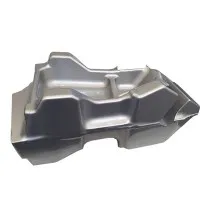
Stress in Aluminum Forgings
Dec 05, 2024
Aluminum forgings will generate a variety of stresses during the forging process, mainly including thermal stress, phase change stress and shrinkage stress. These stresses will have an adverse effect on the mechanical properties and processing accuracy of aluminum forgings.
Thermal stress : Thermal stress is caused by the different cooling rates of various parts of the casting. During the forging process of aluminum alloys, different parts of the casting cool at different rates, resulting in compressive stress in thin walls and tensile stress in thick walls, resulting in residual stress in the casting.
Phase change stress : Phase change stress is the volume change caused by the phase change of aluminum alloy during the cooling process. Due to the uneven wall thickness of aluminum castings, different parts undergo phase change at different times, resulting in changes in volume size, thereby generating phase change stress.
Shrinkage stress : Shrinkage stress is the tensile stress caused by the obstruction of the mold and core when the aluminum casting is shrunken. This stress is temporary and will dissipate by itself when the aluminum casting is unpacked, but if the unpacking time is inappropriate, it may cause thermal cracks.
Methods for eliminating stress
In order to eliminate these stresses, the following methods can be adopted:
Aging elimination method: By performing aging treatment at a lower temperature, the residual stress in the aluminum alloy sheet after quenching can be relaxed and released.
Mechanical stretching method: By applying permanent tensile plastic deformation, the tensile stress and the original quenching residual stress are superimposed and plastic deformation occurs, thereby eliminating the residual stress.
Mold cold pressing method: By performing limited cold shaping in a special finishing mold, the residual stress in the complex shape aluminum alloy die forgings.
Heat treatment: By changing the crystal structure of the aluminum part by heating and cooling, thereby changing its physical properties and eliminating internal stress.
Cold working: Changing the shape and structure of the aluminum part by mechanical force, thereby eliminating internal stress.